Redwork Embroidery, Vintage Quilts, and Hand-Stitched Birds
I’m not sure where it began, maybe the history of Redwork embroidery or red and white quilts—I can’t be sure. But I’ve taken a recent deep dive into the world of Penny Squares, Redwork, and two-tone, antique, patchwork quilts. Red and white quilts, to be specific. For all my love of blue and white textiles, the ubiquitous red and white combination is a close second. However it came to be, I fell down an enchanting rabbit hole of textile research but this time for Redwork embroidery.
From what I’ve read, it was most popular in Britain and the US in the mid 1800s to early 1900s. Also known as Penny Squares, because you could buy the quilt square designs for a penny, these delightful squares were intended to be hand-stitched in red thread on white muslin fabric (Turkey Red thread or, likely, madder root red before the wide use of synthetic dyes around 1850). After accumulating enough squares, you could make a quilt. In the early 1900s the Penny Square quilt kits became popular and then instead of drawing, or transferring, your own design you could order a pre-printed square and stitch atop the printed lines. Brilliant. Time-saving. One step forward in textile publication and printing. Yet I definitely like the early, hand-drawn squares better.
There’s something intimate about drawing. Revealing. Tender. Like peering into someone’s diary filled with imperfect handwriting, glimpsing someone’s illustrations is a vulnerable act. That’s why I love it. Though I’m not very practiced at drawing, there’s something special about a hand-drawn textile. Particularly, if it’s one-of-a-kind. In the age of mass reproductions, AI artwork, and technical overwhelm, a simple line drawing feels like a quiet craft rebellion. And because these embroideries were often a record of everyday objects—birds, flowers, teapots, pets, nursery rhyme characters—they also feel like old journals, of sorts. There were popular themes like US Presidents or other historical figures; sometimes they even include names, greetings, or short phrases. There were trends of state birds and state flowers but I adore the everyday objects and backyard creatures.
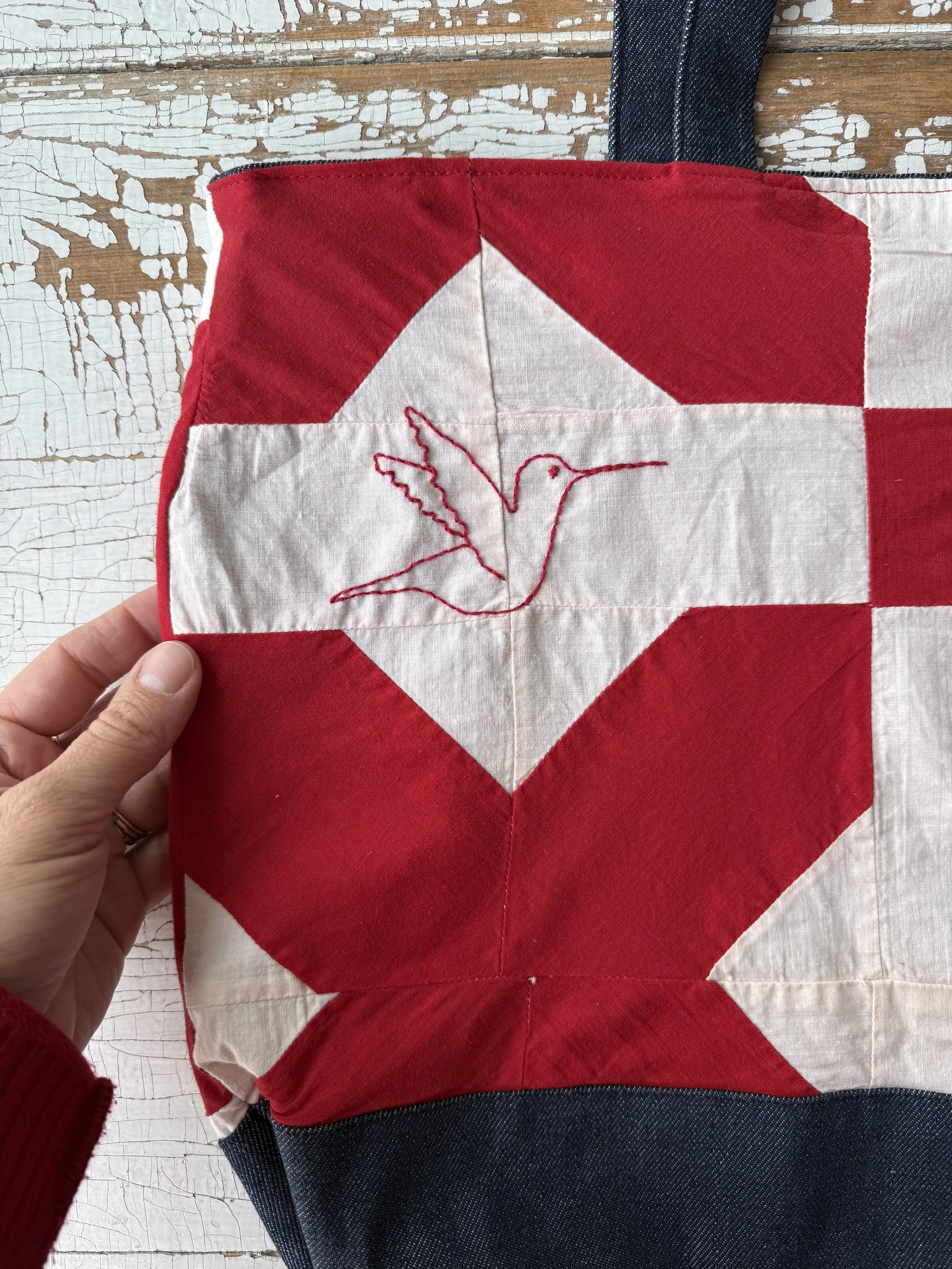
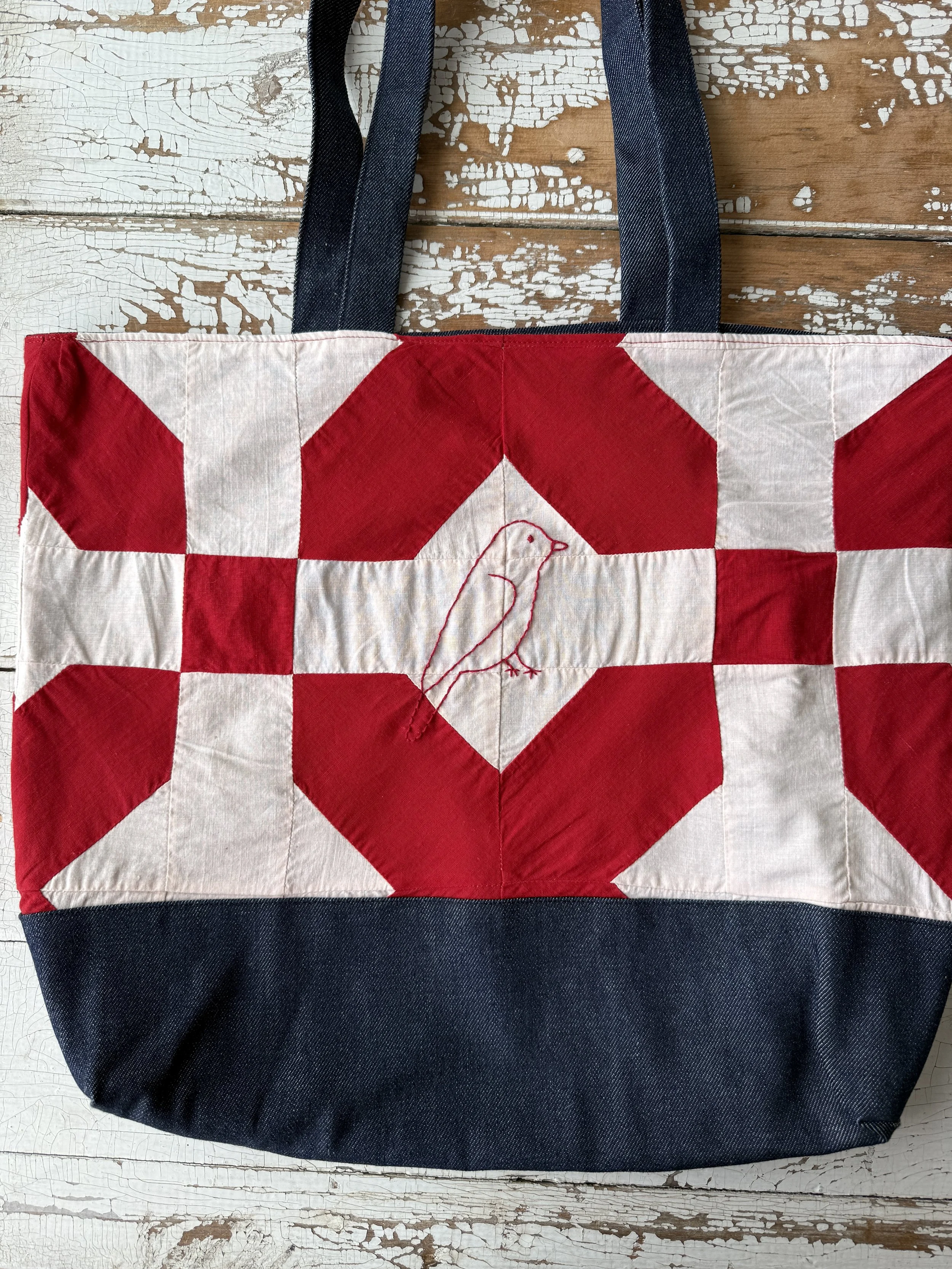
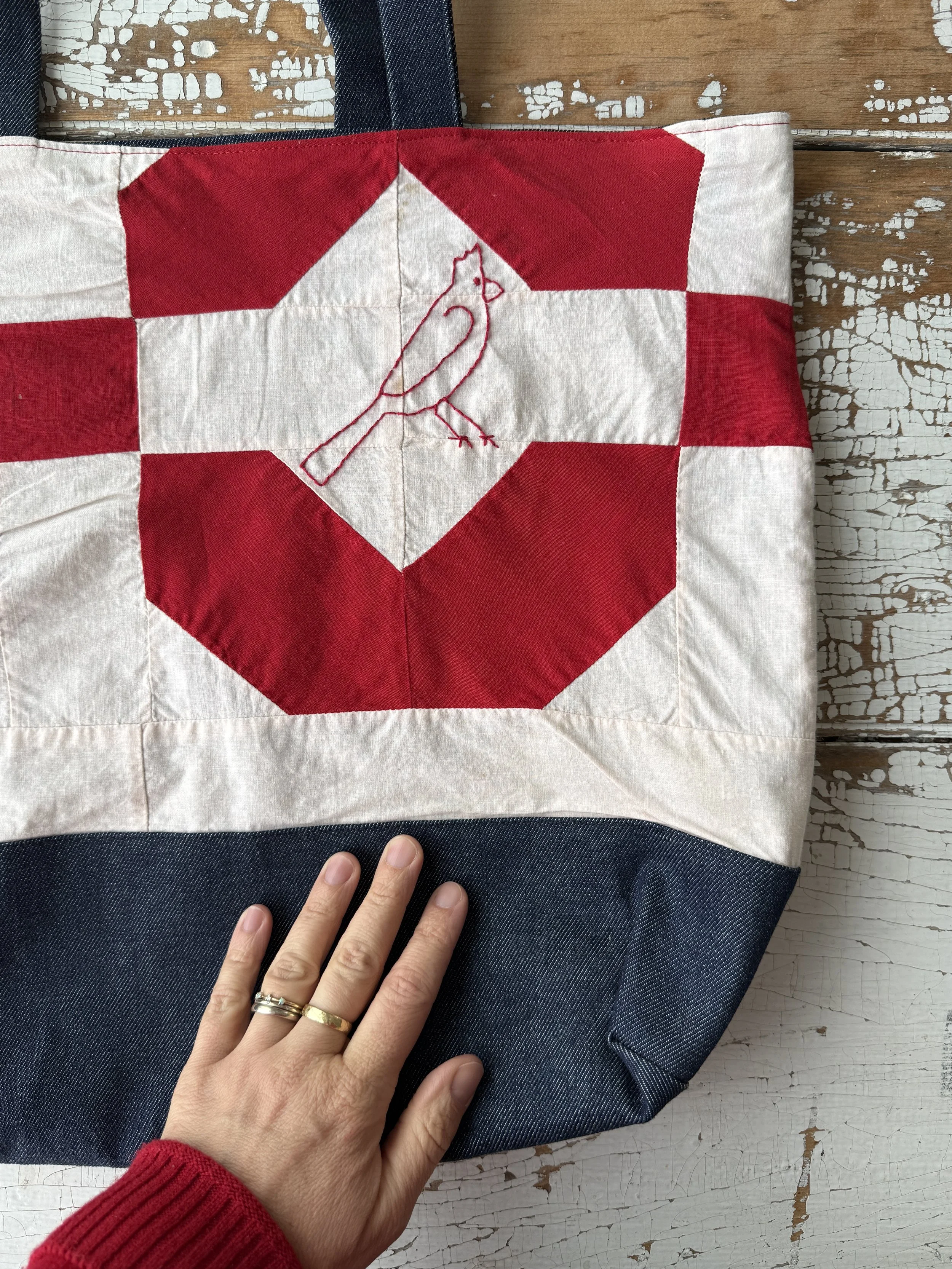
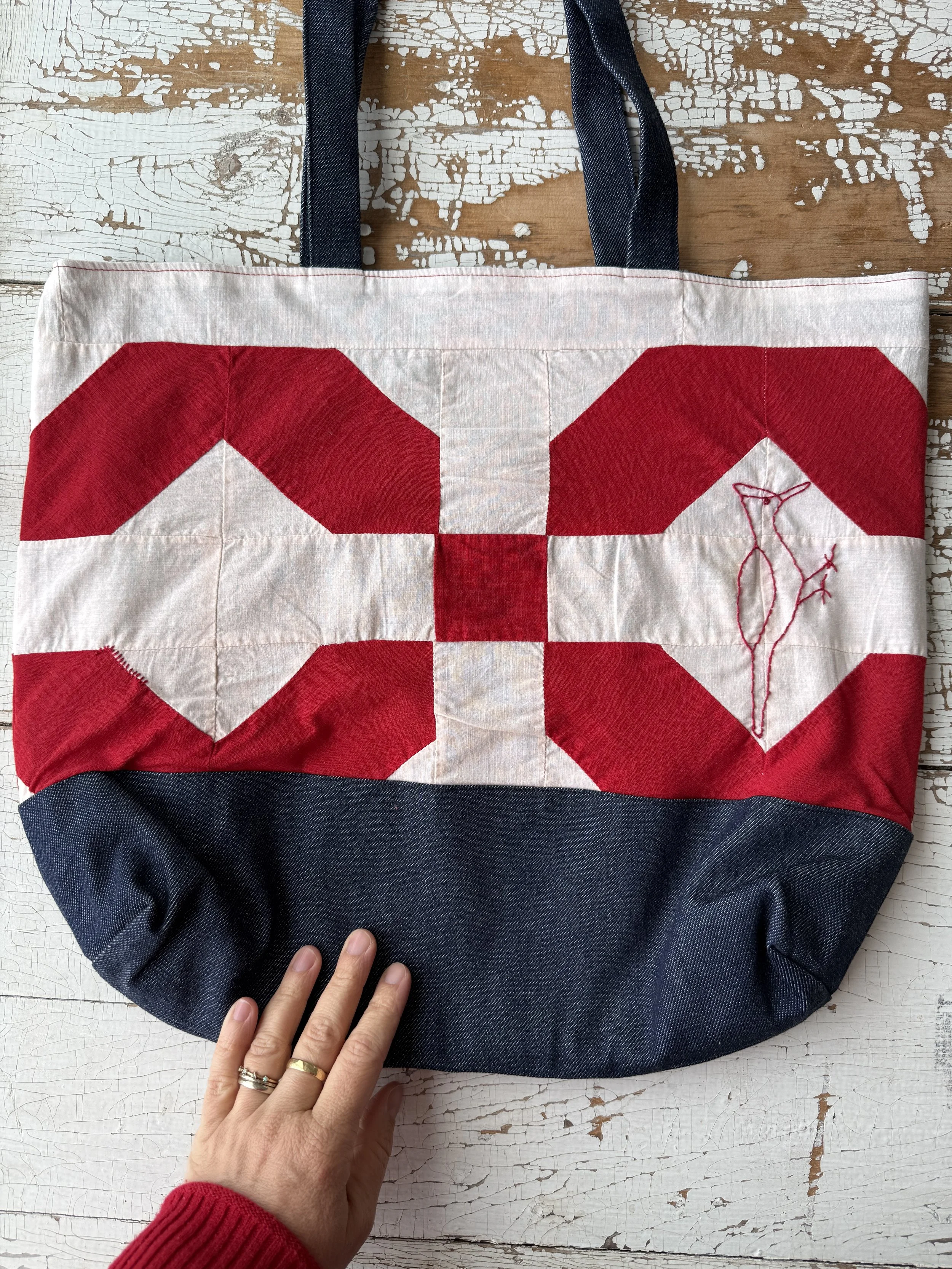
Mostly, Redwork embroidery was a line drawing. Simple, succinct, and fairly beginner-friendly. They often used just basic embroidery stitches like a backstitch, chainstitch, or stem stitch. I love the incredibly tight color palette, distillation of flourishes down to just the most essential stitches, and the concentration on the singular line. Some are strange. Simple. Unbalanced, maybe, in their sparseness. And yet I’m so intrigued by the minimal approach and maximum impact. It’s just red thread on white fabric. But my favorite ones feel so intimate—like I’m sitting with the stitcher at her kitchen table while we wait for the kettle to boil for tea. She just picked up one of her squares in hopes to get a few more stitches finished while we chat. A distant aunt, maybe. An old family friend. A great-grandmother I never met.
Several years ago, I had a few quilt tops and squares made into tote bags. Everyone needs to decide their ethics around reusing quilts—it’s another rabbit hole, though arguably less enchanting. I haven’t yet cut up a pristine antique quilt to make totes or coats and I don’t intend to anytime soon. But I do love redesigning with unfinished quilts—particularly if the top is already stained or tattered or the collection of squares doesn’t amass to an entire quilt.
Most textile artists have an arsenal of UFOs, or unfinished objects, piled up in their craft rooms. And some of you, like me, might also be the lucky recipient in a wider crafting lineage who inherits “unwanted” heirlooms in the form of quilts, needlework, and handmade children’s clothes from distant relatives and family friends. Most folks will downsize considerably, at some point later in life, and the prized textile collection doesn’t always make the final cut of essential belongings. I have no idea what will become of the stacks of textiles in my studio forty years from now. Let’s hope there’s a next generation textile artist in my family’s future. Finger crossed.
But let’s not debate which castoff textiles can and cannot be redesigned or who has that discretion and who doesn’t. I don’t typically cut up finished, useable, beautiful things. But I do find great merit in using existing textiles instead of always buying new fabric. I do think some of the most exciting contemporary designs center on upcycling, remaking, and redesigning. I think they hold incredible potential for our dear planet. And I know it’s much harder to make something stunning when you have to start with what you have—not with what can be delivered to your doorstep. But I’ll just start with me—if some future textile artist decides to cut up my castoff creations to make totes for her one-person studio, it’s okay with me. I’m honored my work has a future in her hands. And I’m honored she wanted what nobody else did. Yet I’m still not cutting up finished, useable, beautiful old textiles anytime soon. I have two beauties waiting to be hung on the walls as I type.
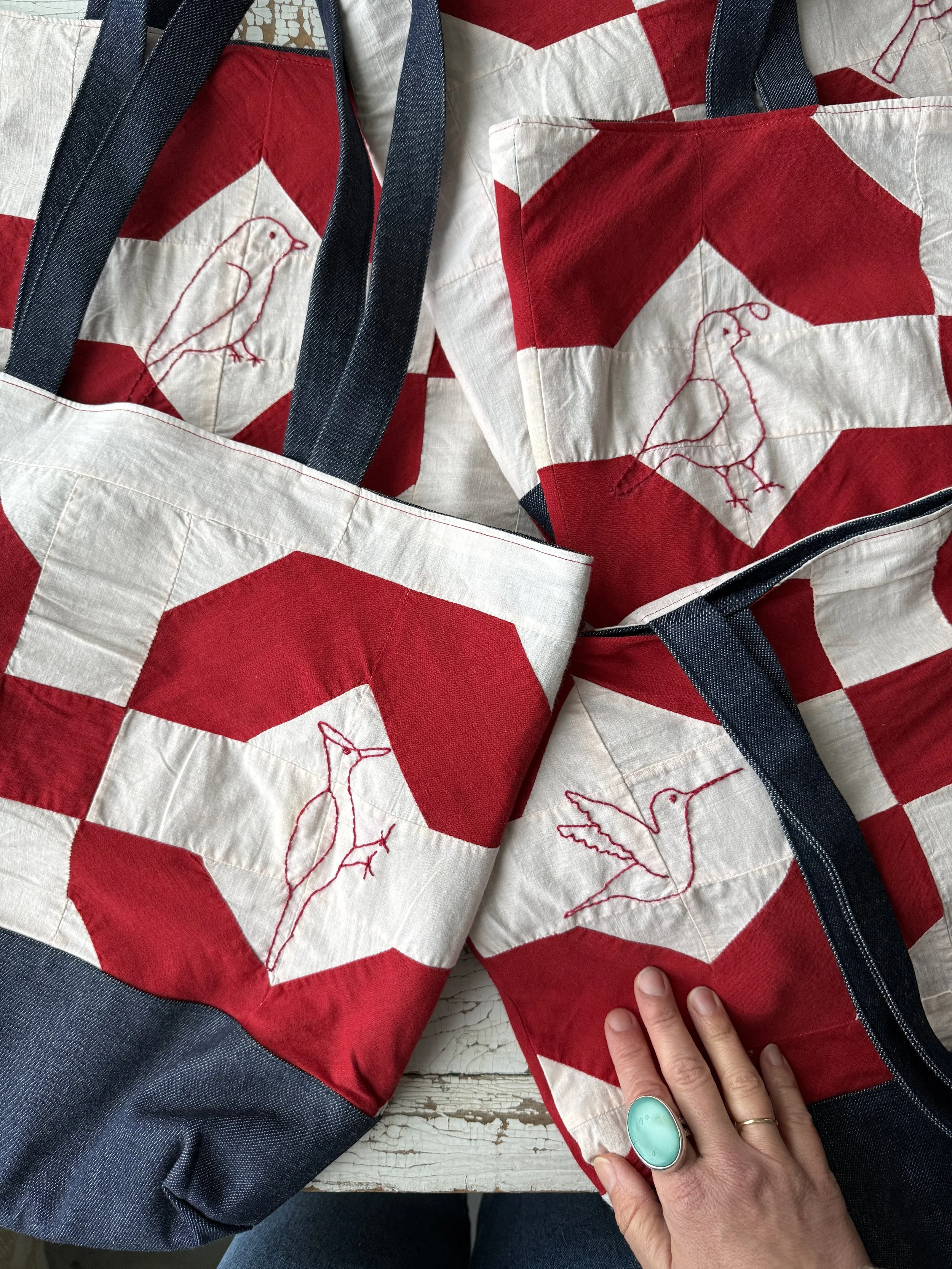
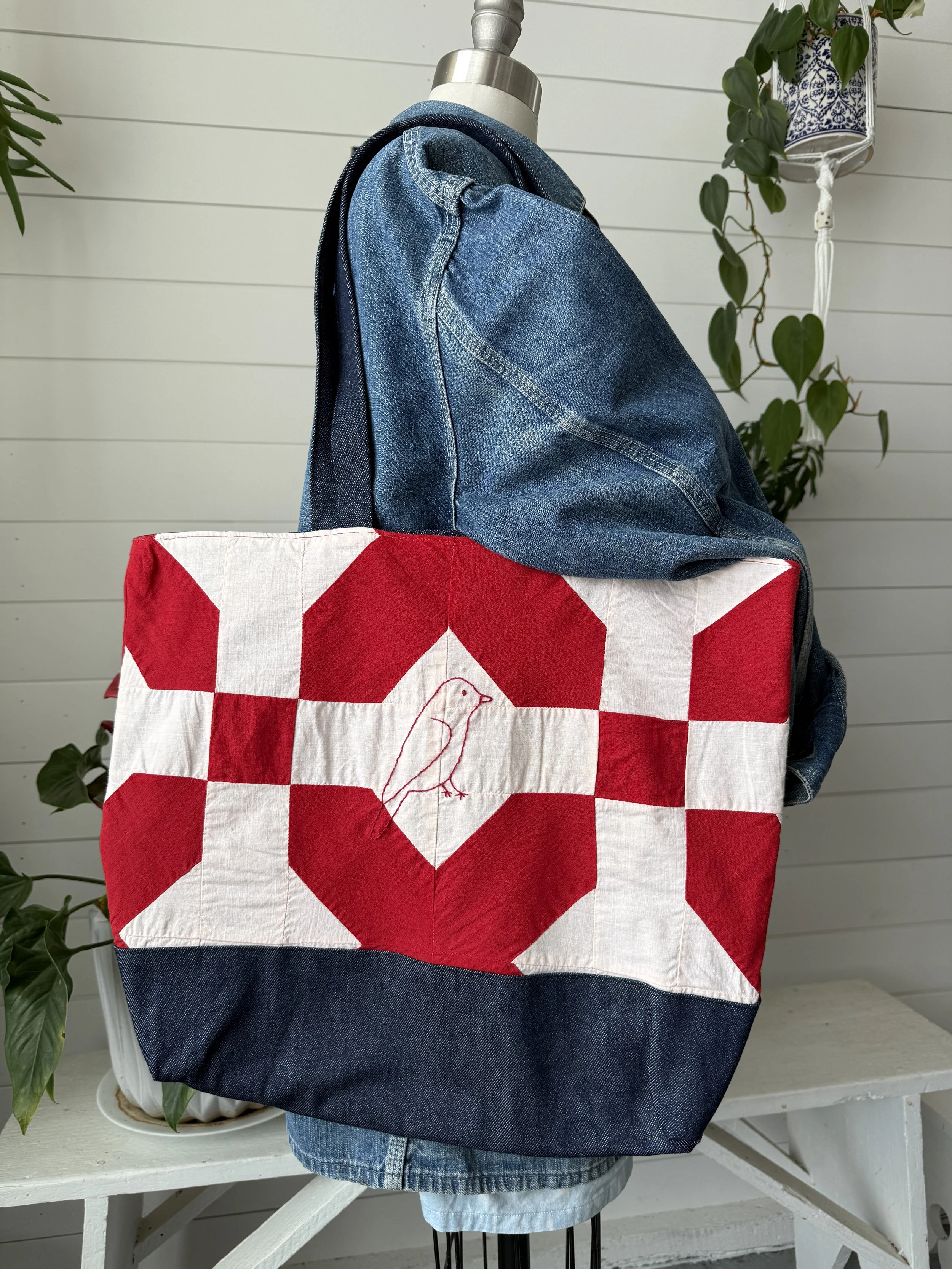
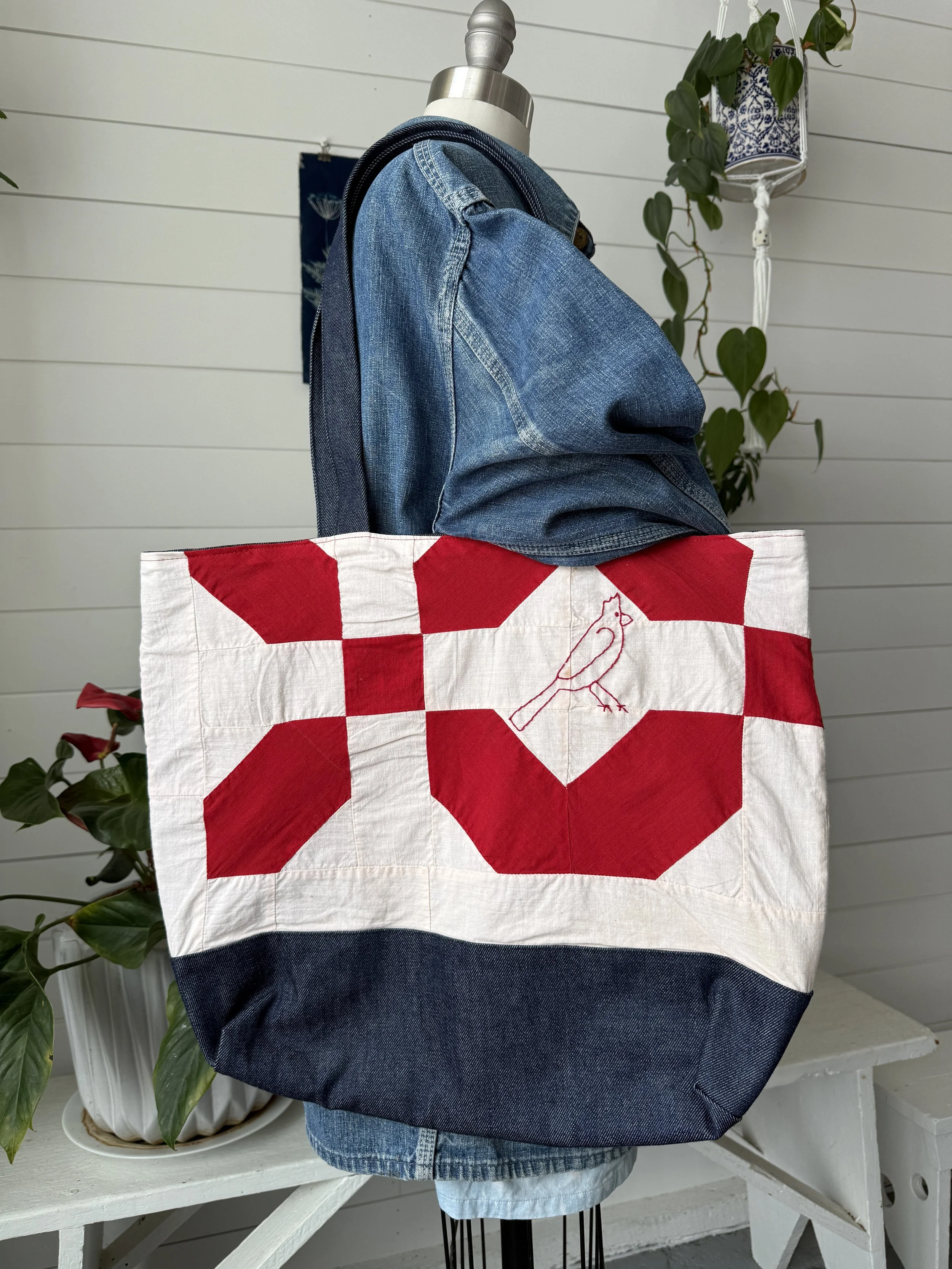
Alas. I made a new small batch of tote bags. These were designed from a red and white antique quilt top and lined with gorgeous, sturdy, selvedge denim. Because I love the mix of fragile handmade textiles against reliable, rustic, rural-friendly workwear like canvas or denim. These totes sat in my studio for years because I felt they needed something else. An element was missing. I kept seeing embroidered red figures on the white squares. Then I made those figures—bird figures—on a handful. Each is completely one-of-a-kind. My kids wouldn’t even let me stitch another hummingbird, they said it was cheating to have two. And now this tiny collection is complete. I couldn’t decide which birds, and as I said, I’m raising two young birders who correct me, regularly, about the anatomy of favorite birds and I’m glad these passed their high standards. With some modifications and edits along the way, mind you. I made five Redwork totes.
I chose a handful of iconic, beloved, favorite North American native birds. I ended with the Eastern Bluebird, Northern Cardinal, Ruby-throated Hummingbird, California Quail, and the Pileated Woodpecker. I can’t tell you exactly why I chose each of these birds aside from how I adore them. My mother loves bluebirds and they often migrate back to NY around her spring birthday—I see one and think of her and the hope that returns with early spring. There are few things as striking as a male Northern Cardinal at the feeder on a snowy day—an exclamation point on a blank page. Hummingbirds in my gardens make my heart sing—like tiny ferries hinting at other magical places or plantdoms. Quails on our hikes in California, often on trails over the Pacific while we hoped to glimpse humpbacks—pure joy. And the Pileated Woodpecker? Well, have you seen one? Are they not adorable, tiny dinosaurs? Relics of another ecosystem. For certain.
There you have it. Redwork embroidery, vintage quilts for redesign, and beloved North American native birds. Add some poetry or strong black tea and we can call it, A List of Some of My Favorite Things. Come to think of it, I did toss some tea in there, waiting for the kettle to boil in an imaginary grandmother’s kitchen and maybe the poetry, this time, is in the stitches. But isn’t that often where textile artists leave their poems?
For more inspiration, check out these books…
My book, Make Thrift Mend, has an entire section on sustainable sewing with how-to projects like using a vintage tablecloth to make a top, adding embroidery to increase value on hand-made garments, and designing patch pockets with fabric scraps.
This book, Red & White Quilts: Infinite Variety, from the American Folk Art Museum, looks like a gorgeous collection of quilts.
I love the book, Slow Stitch: Mindful and Contemplative Textile Art, by Claire Wellesley-Smith and recommend it in my classes.
Vitamin T: Threads and Textiles in Contemporary Art is a wonderful textile book I revisit frequently. So inspiring!